
Last Updated on 8 months ago by Shraddhanvita
Electric cars are becoming increasingly popular. Before, it was very rare to find someone who drove one; they were seen as novelties reserved for the rich, environmental activists, and tech enthusiasts. Today, in 2026, they are the new standard on American roads.
However, shipping an EV is fundamentally different from shipping a standard combustion engine vehicle. The battery that powers those kinds of cars introduces a unique set of logistical challenges, from weight distribution to thermal management.
Hesitation is, understandably, not surprising and completely expected when owners start thinking about shipping their electric vehicle, as many headlines regarding battery fires have created a cloud of anxiety around this type of transport.
Luckily, at Haulin, we are prepared to help you.
In this article, we’ll tell you everything you need to know to ship your electric vehicle without worry.
EV Shipments Are Surging
In the past, it was very rare to find someone who drove a battery-powered vehicle, making shipping them a niche service handled by a few specialists.
Today, in 2026, EVs account for a massive percentage of all vehicles moving across state lines.
This surge in volume has forced the auto transport industry to evolve, adopting an approach that prioritizes battery stability and specialized weight distribution — aspects incredibly important for safely transporting electric vehicles from one point to another.
What is more, drivers who used to haul standard cars are now undergoing specific training to manage these sophisticated systems, ensuring that every EV is transported not just as a vehicle, but as a sensitive piece of technology.
What Makes EV Shipping Different
To the untrained eye, an electric vehicle might look just like any other standard combustion engine car. Nonetheless, when it comes to logistics and transportation, it takes a completely different approach.
The lithium-ion battery fundamentally changes the method of transport, forcing carriers to adjust their loading strategies, insurance limits, and safety protocols, which, in turn, might mean a difference in your quote.
Here are the main differences and why specific rules are non-negotiable in 2026:
Battery Weight
Electric vehicles are incredibly heavy. A massive battery pack can make a mid-sized electric car weigh more than a gas-powered truck.
Auto transport trucks are governed by strict federal weight limits, so as your EV probably takes up more of the driver’s weight allowance, the cost per spot is often slightly higher to compensate for the fewer cars on the trailer.
Lithium Battery Risks
Even though it is not common, battery fires are harder to extinguish than gasoline fires. This is a phenomenon known as “Thermal Runaway,” and it can happen when a damaged battery cell overheats and ignites its neighbors in a chain reaction
To prevent this from happening, there are strict regulations in plac,e such as rigorous pre-load inspections to check for undercarriage damage, and using specific loading positions on the trailer to ensure easy access to the vehicle in an emergency.
So, keep in mind that in your quote, you are also paying for a driver trained to monitor battery stability.
Charging State Rules
It might be your first instinct to deliver your electric car fully charged when waiting for your vehicle to be picked up, so that it’s “ready to go” when it arrives. However, don’t do this, as a fully charged battery is chemically more volatile.
Most carriers now strictly require your EV to have a State of Charge (SoC) at 30%. This is because the driver needs enough power to drive the car onto the trailer and off again.
This range of battery should be enough for you to maneuver it from the delivery place to your desired spot.
Regulations & Safety Requirements (2026)
In 2026, international and domestic transport boards have implemented strict new classifications to track exactly what kind of battery is moving on our highways and oceans.
Compliance isn’t optional — if your paperwork doesn’t match your vehicle, your shipment can be rejected. Here is the regulatory breakdown you need to know:
The 30% Battery Rule
As we explained before, this has solidified into a strict standard, as batteries that are charged below 30% have a much lower risk of sustaining a thermal event if damaged. Drivers are even authorized to deny pickup for vehicles that violate this safety limit.
Transport Classifications
Electric cars are classified by powertrain, and this must be stated in your shipping contract. It usually starts with the generic “UN” followed by a number that indicates more specific characteristics — such as UN 3556, which means Vehicle, Lithium-Ion Battery Powered.
When booking, you must select the correct battery type, as different batteries may require different protocols.
The Documentation
Beyond the specific battery regulations, shipping an EV requires the same foundational shipping paperwork as any vehicle.
This generally includes the bill of lading, proof of ownership, insurance, and photo documentation.
Insurance: What Owners Don’t Know
Insurance is especially important when shipping electric vehicles. In 2026, the unique nature of these cars has exposed massive holes in standard cargo policies.
So, before you hand over your keys, here are the three specific gaps you need to close:
The Cargo Insurance Limit
Standard auto transport carriers typically carry $250,000 to $350,000 in total cargo insurance. This, for a sophisticated state-of-the-art electric vehicle, might only get you pennies on the dollar for your car if damage occurs.
So, if you are shipping a high-value EV, ensure its limit is at least $500,000 or purchase a gap policy for the trip.
“Diminished Value” is Not Covered
As electric cars are such delicate cargo, any scratch can mean a significant value drop. Standard carrier insurance pays for repairs, not the lost resale value.
Make sure to check if your personal auto policy says anything about covering diminished value, or hire a carrier that offers full value replacement guarantees.
The Battery Exclusion
What happens if your battery dies during the trip? In normal situations, if your battery dies, you just recharge it as soon as you get the opportunity to do it. However, if it dies during transit, there’s no way to charge it until the car gets delivered.
If your battery spends too much time at 0%, it might get permanently damaged, so follow the 30 – 50% rule religiously, because if the battery dies because you didn’t charge it enough, that bill is on you.
Best Practices for Safe EV Shipping
Shipping an electric vehicle requires a different playbook than shipping a gas car. Because the most expensive component — the battery — is located a very short distance from the ground, and the vehicle is heavier than average, shipping methods often fall short.
To guarantee a safe journey in 2026, follow these three best practices:
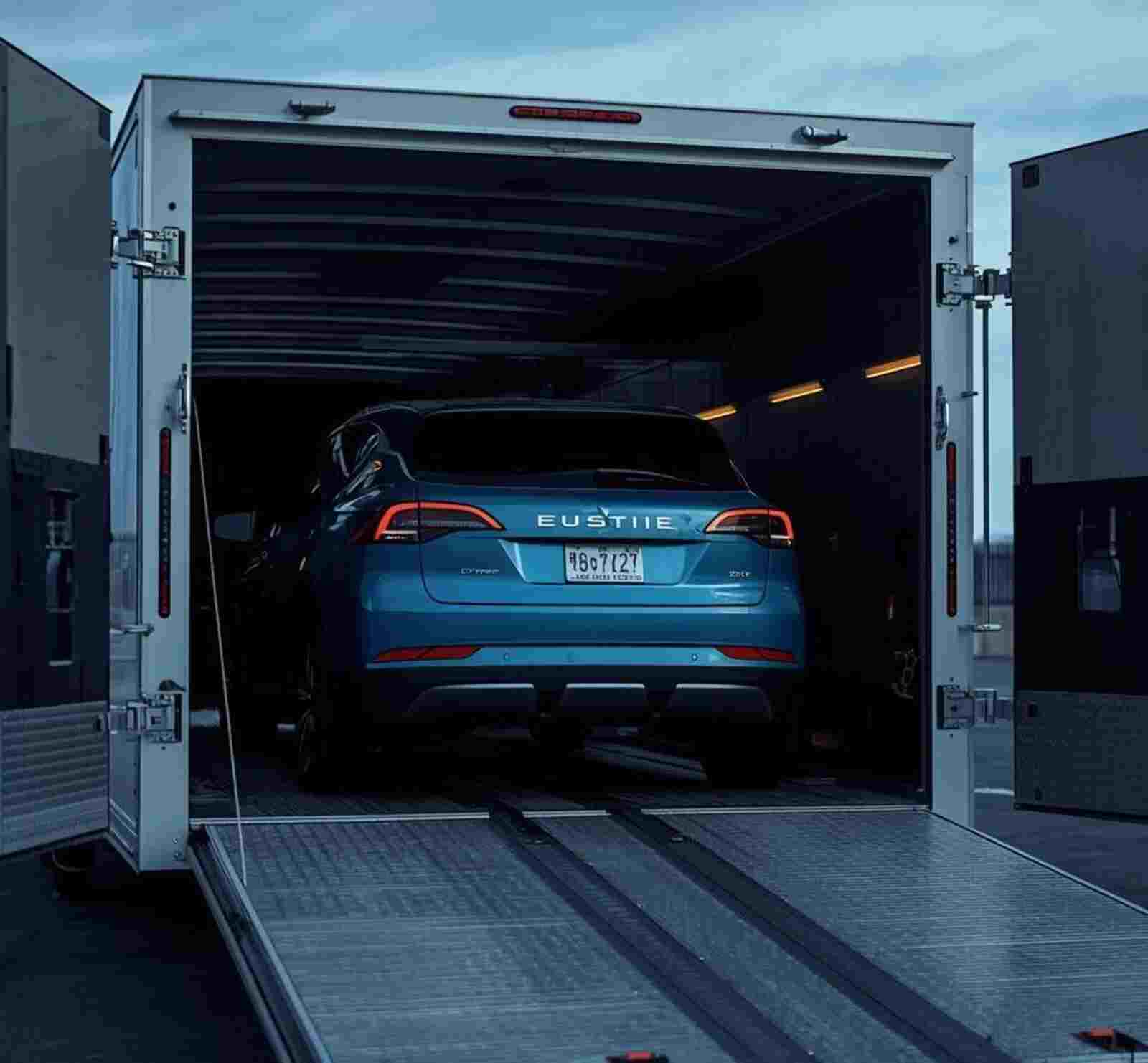
Choose Enclosed EV Transport
This is especially crucial when it comes to low clearance vehicles. As open trailers use steep ramps to load cars, many performance EVs have a high risk of scraping on the ramp.
A scrape on the undercarriage can dent the battery’s protective shield, potentially voiding your battery warranty.
The Undercarriage Inspection
When the driver arrives for pickup, most people just look for scratches on the door. For an EV, you need to look lower.
Use your phone to take a video of the entire underbody of the car before loading, and also photograph the charging cable if you are shipping it. These are frequently lost or stolen.
Follow The 30-50 Battery Rule
Again, we need to stress the importance of this rule.
Remember, 30% is the minimum because if the battery dies in transit, the car effectively becomes a “brick” that cannot be put in neutral, requiring a specialized winch to drag it off the truck.
How AI Enhances EV Safety
We’ve already established that EV’s are more complex and require special, delicate care. This is why technology — specifically AI-driven systems — is crucial for filtering out the noise.
At Haulin, we also take into account the electric vehicle market. We don’t just look for a truck; we look for the safest carrier.
Here is how our technology protects your valuable asset.
Our AI-powered, intelligent platform runs a deep historical analysis on every potential carrier. We look for EV experience metrics such as a history of hauling high-weight loads safely, Hazmat training for lithium batteries, and modern strapping equipment that avoids touching the undercarriage.
Also, we integrate with the driver’s GPS systems to monitor progress in real-time, giving our customers immediate alerts regarding the safety and progress of their shipment. This way, we can ensure a secure process from beginning to end.
Conclusión
Shipping an electric vehicle is a much more complex process than shipping a standard car. However, it doesn’t have to be a dangerous one.
In 2026, technology, more specifically AI systems, has come to integrate safety and security into the whole process, allowing you to ship your electric vehicle seamlessly and safely to your door.
Choose Haulin, a service that understands the science of safety.
Get your instant personalized quote now!

**About the Author — Shraddhanvita Tiwari**
Shraddhanvita Tiwari is an auto transport industry expert specializing in vehicle shipping, auto transport logistics, carrier networks, and the U.S. car shipping market. Her experience in the industry gives her a practical perspective on the factors that influence auto transport pricing, carrier selection, shipping timelines, and the overall vehicle shipping experience. At Haulin.ai, she contributes industry-focused insights designed to make car shipping easier to understand for consumers and businesses.